Almost every buyer who tours a home in Troon North asks the same question within the first ten minutes: "What are the HOA fees?" It sounds like a simple question. In Troon North, it isn't — because the honest answer involves three separate things that most people assume are one.
There is the master association fee. There is a second, entirely separate fee charged by whichever of the community's nineteen sub-associations governs the specific street the home sits on. And then there is Troon North Golf Club, which is not an HOA expense at all, is not owned by the community, and does not require a single dollar from homeowners who never intend to play.
Buyers who don't understand the distinction routinely mis-budget by hundreds of dollars a month in either direction. Some assume the low master fee they saw on a listing sheet is the whole story and get surprised at closing. Others assume that living in a community with two championship golf courses means a mandatory five-figure initiation fee and walk away from a neighborhood that would have suited them perfectly.
This guide breaks down what the Troon North HOA actually covers, what the golf club costs separately, and how the whole structure compares to neighboring Troon Village — a community that looks similar from Pinnacle Peak Road but is governed on meaningfully different terms.
How Troon North Is Structured
Troon North was established in 1989, timed to the opening of the Monument Course, and today spans roughly 1,800 acres holding somewhere between 1,200 and 1,300 single-family homes, townhomes, and condominiums.
The governance model is two-layered. At the top sits the Troon North Association — the master association — managed by FirstService Residential from an onsite office at 28190 N. Alma School Parkway, Suite 211, Scottsdale, AZ 85262. The master association handles what you might call the connective tissue of the community: regional trail networks, community-wide monument signage, street lighting along primary thoroughfares like Dynamite Boulevard and Alma School Parkway, Natural Area Open Space conservation, and the reserve funding behind all of it.
Beneath the master sit nineteen subdivisions, each with its own active sub-association, its own board, its own rules, and its own dues. Talus, Candlewood Estates, Pinnacle Canyon, The Ridge, Quisana, Stonedge, On the Green, Skyline Estates, Boulder Crest, Echo Ridge, Estates at Troon North, Golf Villas, Monument, Pinnacle Canyon Las Ventanas, Pinnacle Ridge, Pinnacle Views I and II, Balancing Rock, and Parcel D-1A. Most are gated. Candlewood Estates is guard-gated with live staffing. A handful — Balancing Rock, Monument, and the two Pinnacle Views subdivisions — are not gated at all.
This is the single most important thing to understand: nearly every homeowner in Troon North pays two HOA bills, not one. A listing that advertises "$45/month HOA" is quoting the master fee only. The sub-association fee sits on top of it, and depending on the subdivision, it can be ten times larger.
Two clarifications worth making, because both come up constantly in listing copy:
Sonoran Fairways is not an official subdivision within the Troon North master association. Agents use the name informally to market homes along the back nine, but those properties actually sit within recognized subdivisions like Monument or Talus. If you see it on a listing, ask which subdivision the home is legally in — that's the one whose dues and CC&Rs you'll be bound by.
Windgate Ranch is not part of Troon North at all. It's a separate Toll Brothers master-planned community roughly ten miles south near Thompson Peak Parkway and Bell Road.
Finally: there are no non-HOA parcels inside Troon North. Every lot within the master boundary is subject to master CC&Rs and dues plus its sub-association. You will occasionally see custom acreage along 111th Street or up near Dynamite Road marketed as "non-HOA Troon North." Those parcels are unincorporated Maricopa County land outside the master boundary. They carry no dues — and no access to Troon North's governance, amenities, or resident golf privileges either.
What the Master Association Fee Actually Covers
Master association dues currently run approximately $120 to $150 per quarter, or roughly $40 to $50 per month. By luxury-community standards in North Scottsdale, that is remarkably low.
The reason is structural. The master association isn't maintaining a clubhouse, a fitness center, a resort pool complex, or a staffed amenity campus. Its assets are desert land, trails, stone entry monuments, and roadway lighting — low-capital, low-replacement-cost infrastructure. Fewer expensive things to eventually replace means smaller reserve obligations, which means lower dues.
That same math explains the fee history. Master dues have been comparatively stable, with increases typically arriving every two to four years and tracking inflation in landscaping and desert-preservation maintenance rather than reacting to major capital events.
What the master fee buys you: regional trail maintenance, community-wide monument signage, primary thoroughfare lighting, NAOS desert conservation management, master infrastructure reserve contributions, and community social and educational programming.
On reserve health, the master association maintains a professionally updated 30-year reserve study, refreshed every three to five years in line with industry practice, and has historically held a strong funding position at 70% or better. In reserve-study terms, anything above 70% funded is considered healthy and unlikely to require a special assessment. The master association has no recent history of one and no active plans for one.
What the Sub-Association Fee Covers, and Why It Varies So Much
Sub-association dues are where the real variation lives, and they scale almost entirely with two factors: whether the subdivision has private streets, and whether it has a live human at the gate.
Non-gated subdivisions run roughly $25 to $100 per month. These fees cover local street lighting, small internal common areas, and neighborhood signage. There's simply not much to maintain.
Electronically gated subdivisions run roughly $150 to $350 per month. Here you're funding gate electronics and their eventual replacement, private interior street paving and slurry sealing, perimeter wall maintenance, and desert buffer landscaping within the enclave.
Guard-gated communities — Candlewood Estates being the example within Troon North — run $350 to $600 or more per month. The jump is almost entirely labor. Staffing a gate around the clock is a payroll line item, and payroll doesn't shrink.
Townhome and condominium enclaves like On the Green, Stonedge, The Ridge, and Golf Villas run $300 to $550 or more per month, and these dues are structurally different from single-family dues because they include exterior structure maintenance, blanket hazard insurance on the buildings, community pools and spas, private street maintenance, and common element landscaping.
A practical framing for buyers: a higher condo or townhome HOA fee is not automatically a worse deal. If your dues include roof maintenance, exterior paint, landscaping, hazard insurance, and trash, you are prepaying expenses a single-family owner absorbs separately and unpredictably. Compare total cost of ownership, not the HOA line in isolation.
Utilities and Landscaping
For single-family homes, whether gated or not, none of this is included. Homeowners handle their own City of Scottsdale water and sewer, City of Scottsdale trash collection, and all front and rear desert landscaping.
For condo and townhome enclaves, front-yard and exterior maintenance is included in sub-HOA dues, and trash is generally included through shared dumpsters or consolidated service. Water and sewer are typically still billed separately by the City of Scottsdale, though a small number of condo budgets fold water and sewer into the operating assessment. Verify this specific line before you write an offer — it materially changes the monthly comparison.
Reserve Funding at the Sub-Association Level
This deserves emphasis. The master association's strong reserve position tells you nothing about the sub-association you're actually buying into.
Sub-associations that maintain private roads, gate mechanisms, aging roofs, or pool decks carry substantially higher capital obligations, and funding levels across the nineteen sub-associations vary considerably. A gated enclave facing an asphalt overlay cycle or a townhome community approaching roof replacement is where special assessment risk actually lives in Troon North. That evaluation has to happen individually, through the sub-association's own resale certificate during escrow.
What the HOA Does Not Cover: Troon North Golf Club
Here is the part that resolves most of the confusion.
Troon North Golf Club is not owned by the community, not funded by HOA dues, and not attached to your property. It is a privately owned commercial golf facility, managed by Troon — the largest golf course management company in the world, which originated at this very property. Homeowners hold no equity in it, no proprietary interest in the clubhouse, and no obligation to contribute to course capital reserves.
There is zero mandatory golf membership tied to owning real estate in Troon North. You can buy a home here, never touch a club, and pay nothing toward it.
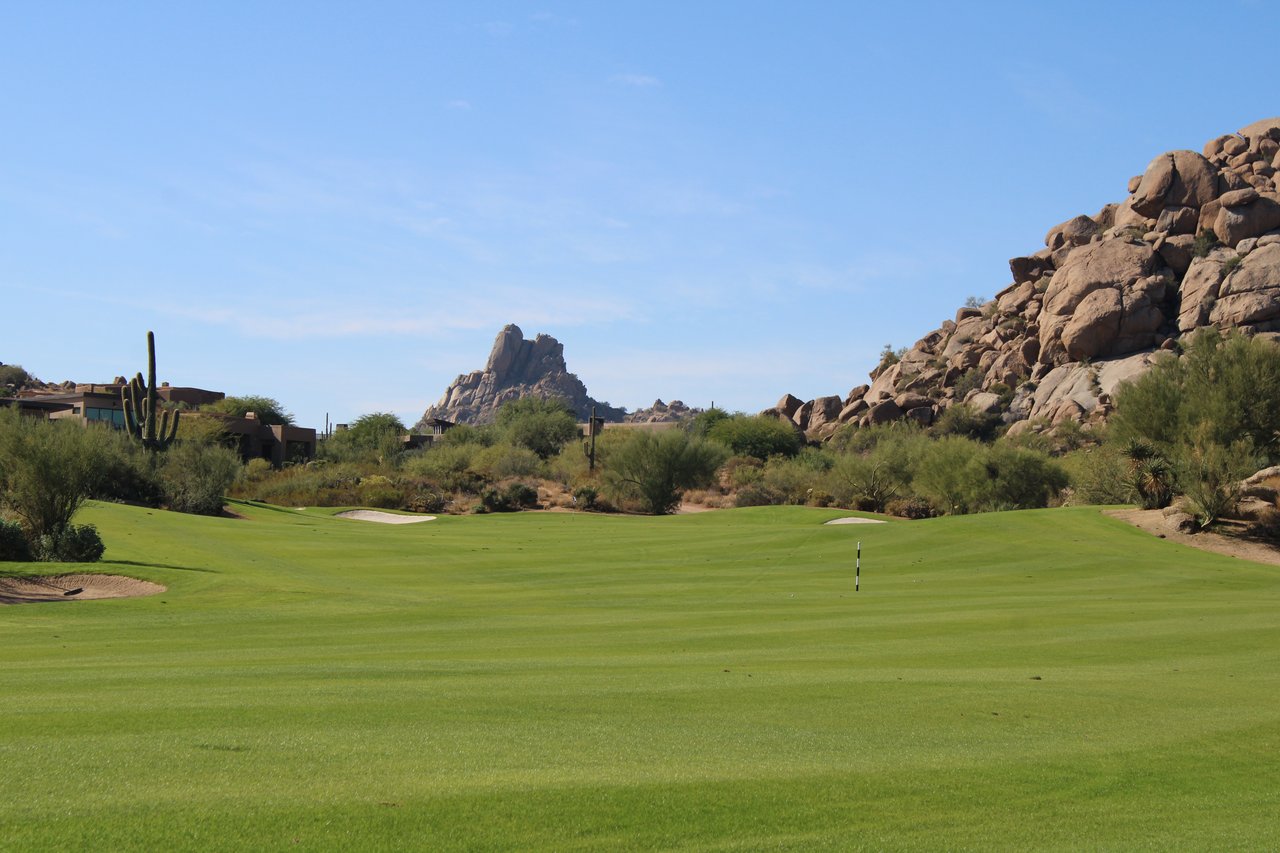
The club operates as semi-private. Both the Monument Course and the Pinnacle Course are fully open to daily-fee public play year-round, with tee times bookable online up to 30 days ahead or further out through resort packaging. Both are 18-hole championship layouts by Tom Weiskopf routed through natural Sonoran Desert terrain. The Monument is par 72 at up to 7,039 yards, known for wide fairways, dramatic elevation change, and the enormous boulder sitting mid-fairway on the third. The Pinnacle is par 71 at up to 7,009 yards, tighter and more target-oriented, with steeper arroyos and closer integration with Pinnacle Peak's granite outcroppings.
If You Do Want a Membership
Full Golf Membership carries an initiation fee reported in the range of $35,000 for the non-refundable option to $75,000 for the partially refundable option, with monthly dues in the neighborhood of $510 to $565. Full memberships have periodically sold out with an active waitlist. Benefits include no greens fees, a 30-day priority booking window ahead of public access, complimentary range use, discounted guest rates, and 20% off apparel and dining at the Dynamite Grill.
Troon North Resident Preferred Membership costs nothing. No initiation, no monthly dues. Every property owner inside the Troon North HOA qualifies for a complimentary Resident Card providing reduced green fees for the owner and guests, plus preferred advance booking privileges.
That second program is genuinely the underrated part of buying here. A resident who plays a dozen rounds a year gets meaningful discounted access for zero carrying cost. The full membership makes financial sense for high-frequency players who want guaranteed prime tee times in season — which, in North Scottsdale, is the whole point.
Full members also gain the Troon Advantage network: preferred pricing and advance tee times at more than 150 Troon-managed facilities worldwide. Non-member residents can separately purchase annual Troon Cards for 30–50% off public rates at participating local Troon courses.
Membership pricing and availability at private and semi-private clubs change without public notice. Confirm current initiation figures, dues, and waitlist status directly with the club before making a purchase decision that depends on them.
Troon North vs. Troon Village: A Real Structural Comparison
These two communities sit minutes apart, share a name, and get conflated constantly. They are not the same thing.
Troon Village Association serves as master HOA for approximately 1,300 home sites wrapping around Troon Mountain, using the same two-layer model with twelve sub-associations — including guard-gated Artesano and Glenn Moor, gated Windy Walk Estates high on the mountain, the attached-home enclave of Ballantrae Ridge, non-gated Desert Views and Four Peaks, plus Quail Ridge, Skye Top, Troon East/Saddleback, Troon Fairways, Troon Mountain Community Association, Tusayan, and Whispering Ridge.
The Club Distinction Is the Real Difference
Neither community imposes mandatory club membership on homeowners. But the clubs themselves operate on opposite models.
Troon Country Club, serving Troon Village, is a strictly private, member-owned equity club with no public daily-fee access whatsoever. Troon North Golf Club is a semi-private, commercially managed daily-fee facility with public tee times.
The practical consequence for buyers: in Troon North, guests can play the courses your home overlooks. In Troon Village, they cannot unless you belong. If you regularly host visiting family or clients who golf, that difference matters more than any dues figure in this article. If you value the quiet of a course that never sees a public tee sheet, it cuts the other direction.
Age, Terrain, and Character
Attribute | Troon Village | Troon North |
|---|---|---|
Development era | 1980s–mid-1990s | 1990s–2000s+ |
Topography | Steeper, mountainous; dramatic ridgeline slopes around Troon Mountain | High-desert plateau with granite boulder outcroppings |
Architecture | Southwestern, Territorial, Mediterranean, traditional Santa Fe | Southwestern desert organic, Santa Fe, contemporary desert modern |
Lot sizes | Patio homes through 1–2+ acre hillside plots with building envelopes | Townhome lots through 0.75–1.5+ acre custom desert sites |
Typical price range | $900K–$6M+ | $800K–$4.5M+ |
Both communities sit entirely within City of Scottsdale limits — ZIP codes 85255 and 85262 — with no county islands in either.
Dues Side by Side
Category | Troon Village | Troon North |
|---|---|---|
Master HOA | ~$100/mo (~$300/qtr) | ~$40–$50/mo ($120–$150/qtr) |
Non-gated sub-HOA | $30–$100/mo | $25–$100/mo |
Electronic-gated sub-HOA | $150–$350/mo | $150–$350/mo |
Guard-gated sub-HOA | $400–$700+/mo | $350–$600+/mo |
Condo/townhome sub-HOA | $350–$550/mo | $300–$550+/mo |
Figures accurate as of the date of publication. HOA assessments are set by annual board budget vote and change. Verify current dues through the resale disclosure package on any specific property.
The headline difference is at the master level, where Troon Village runs roughly double Troon North. Sub-association fees land in broadly comparable ranges, which makes sense — a gate costs what a gate costs regardless of which side of Pinnacle Peak Road it sits on.
Transfer Fees and Capital Contributions at Closing
Beyond monthly dues, buyers should budget for one-time charges at close of escrow.
The master association capital contribution or working capital fee typically runs one to two times the quarterly master assessment — roughly $150 to $300 — or a set administrative amount. By Arizona real estate custom, the buyer pays this at closing.
Sub-association working capital or reserve fees are common, particularly in condominium and gated communities, and often equal two to three months of sub-HOA dues. Also customarily buyer-paid.
The HOA disclosure or resale certificate fee runs approximately $400 to $500 per association. Note the phrase per association — in Troon North, you'll typically be paying for two disclosure packages, not one. Under Arizona law, the seller is responsible for providing required HOA disclosure materials to the buyer.
Architectural Review, NAOS, and the Rules That Actually Constrain You
HOA dues buy services. CC&Rs constrain behavior. In Troon North, the second category is stricter than most buyers anticipate, and it's worth understanding before you fall in love with a renovation plan.
Architectural Review Committee
Any exterior modification — paint, additions, pool installation, landscape alteration — requires submittal to the Troon North Architectural Review Committee. Major construction moves through multi-stage review: preliminary plan, final plan, and pre-construction onsite inspection.
The ARC meets on a set monthly schedule and has up to 30 days to review a complete standard submittal. Major custom builds routinely take 60 to 90 days across iterative preliminary and final approvals.
Fees scale accordingly. Minor landscape or paint submittals carry modest fees in the $25 to $100 range. Custom home builds and major structural additions require a non-refundable design review fee of roughly $2,500 to $2,750, plus a $10,000 refundable construction compliance deposit held by the association until final inspection approval.
Light Reflective Value
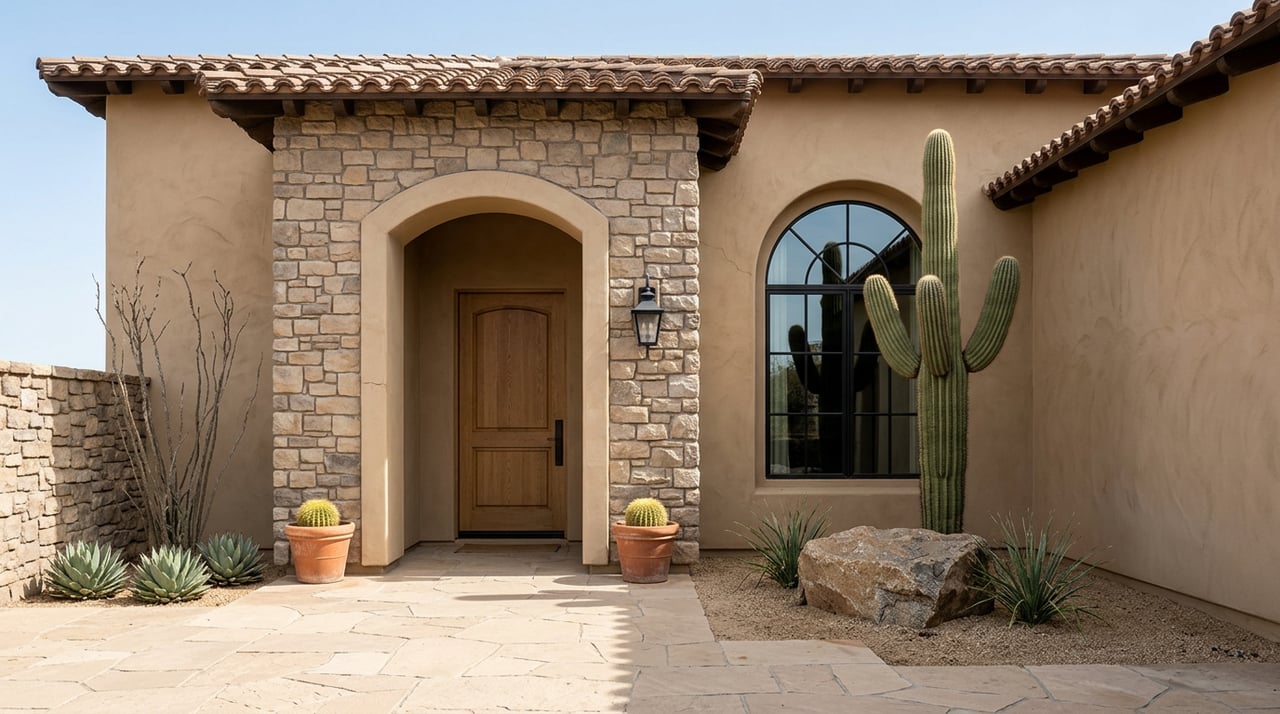
Troon North mandates that all exterior body paint fall within a Light Reflective Value between 14 and 40. Bright whites and high-LRV finishes are prohibited outright. Body, trim, and accent colors must sit in muted earth tones — grays, tans, browns, desert greens — that recede into the surrounding terrain.
If your design vision involves a crisp white contemporary exterior, Troon North is not the community for it. This is not a negotiable preference; it's a recorded restriction.
Natural Area Open Space
NAOS is a permanent deed-restricted conservation easement, and the restrictions are absolute. Within a NAOS area, homeowners cannot clear, grade, excavate, build walls, add a pool, install turf, construct a ramada, or run irrigation.
The maintenance rules surprise people even more. Native vegetation inside NAOS must remain in its wild state. Trimming, shearing, or removing plants — including dead trees and cactus — is prohibited unless the plant presents an imminent public safety or fire hazard. Dead wood is native wildlife habitat and stays where it falls.
Before you buy a lot expecting to expand a yard, extend a patio, or add a casita, have the NAOS boundaries identified on a survey. The buildable area on a Troon North lot is often significantly smaller than the parcel acreage suggests.
ESLO and City of Scottsdale Approvals
Every parcel in Troon North falls under Scottsdale's Environmentally Sensitive Lands Overlay, which imposes strict limits on maximum disturbance area, building height, wall placement, and site coverage.
Critically, HOA approval does not substitute for City approval. Major modifications require dual clearance: first from the Troon North ARC, then from City of Scottsdale Development Services, and from the Development Review Board where applicable. Budget the timeline for both.
Two additional layers apply. Scottsdale's dark sky ordinance requires all exterior fixtures to be fully shielded, downward-directed, and low-lumen; unshielded spotlights and sky-directed uplighting are prohibited. And protected native plants — saguaro, ocotillo, ironwood, palo verde — are covered under Arizona Native Plant Law and city code. Construction that disturbs protected species outside NAOS requires tagging, boxing, and on-site salvage.
Short-Term Rentals
Arizona's state preemption statute, A.R.S. § 9-500.39, sharply limits the ability of cities like Scottsdale to ban short-term rentals. But the statute explicitly exempts private CC&R contracts — meaning HOAs retain authority the city does not have.
The Troon North master association maintains minimum lease restrictions, typically requiring 30-day minimum terms. Individual sub-associations frequently go further, enforcing 30-day, 90-day, or six-month minimums. Very few enclaves permit nightly or weekend rentals.
Practically speaking, most of Troon North is not viable as a short-term vacation rental. If rental income is part of your acquisition thesis, confirm the specific sub-association's minimum lease period in writing before you go under contract. Do not rely on the state preemption statute — it doesn't reach the HOA.
What to Request During Due Diligence
Arizona law gives buyers a structured window to evaluate all of this. Use it.
Under A.R.S. § 33-1806 for planned communities and § 33-1260 for condominiums, disclosure obligations depend on association size. For associations of 50 or more units — which includes both the Troon North and Troon Village master associations — the association or management company must deliver the full disclosure package directly to the buyer within 10 days of receiving written notice of a pending sale. For associations under 50 units, which describes several smaller sub-associations, the seller delivers the package directly within 10 days of offer acceptance.
Once received, the buyer has 10 calendar days to review and cancel without penalty if the disclosed terms are unacceptable.
Arizona also caps what associations may charge: $400 maximum for the base resale disclosure, $100 maximum rush fee if documents are needed within 72 hours, and $50 maximum for a document update after 30 days. Fees may be charged only once per transaction and must be collected at close of escrow rather than upfront.
Within the package, five documents carry the most weight:
The current operating budget and financial statements reveal whether the association is running a deficit and whether budgeted reserve contributions are actually being funded.
The most recent reserve study gives you the percent-funded ratio. Above 70% is strong. Below 30% signals meaningful special assessment risk.
Open meeting minutes from the past three to six months are the most honest document in the packet. This is where deferred maintenance, vendor cost spikes, and pending assessment votes get discussed before they show up anywhere official.
The statement of pending litigation discloses lawsuits naming the association — construction defect claims and vendor disputes being the common varieties.
Special assessment history and unpaid violation records confirm whether an assessment is active or approved, and whether the specific property carries outstanding architectural violations you would inherit.
On current status: neither the Troon North nor the Troon Village master association has a recent history of, or active plans for, a community-wide special assessment. Both maintain healthy master-level finances. The risk sits at the sub-association level, where private roads, gate mechanisms, and aging roofs and pools occasionally trigger localized assessments. Your escrow disclosure will surface any pending or approved sub-HOA obligation before closing — provided you read it.
Working With an Agent Who Knows the Structure
The fee structure in Troon North isn't complicated because anyone designed it to be. It's complicated because a 1,800-acre community built across three decades with nineteen sub-associations, a conservation easement regime, a city overlay ordinance, and an independently owned golf club naturally accumulates layers.
What that means for a buyer is that the useful questions are specific ones: which sub-association governs this exact street, what is that sub-association's reserve funding percentage, where do the NAOS boundaries fall on this particular lot, and what minimum lease term applies here.
Torie Ellens and The Torie Ellens Team at Premium AZ Homes have built their practice on exactly that kind of transaction-level precision across North Scottsdale, with over $458 million in total sales volume and a 98.6% list-to-sale price ratio — figures that reflect a negotiation and contract strategy discipline rather than volume for its own sake.
If you're evaluating Troon North against Troon Village, weighing a gated enclave against a non-gated lot, or trying to understand whether a particular property's dues and restrictions actually fit how you intend to live in it, that's a conversation worth having before you tour.
Torie Ellens The Torie Ellens Team at Premium AZ Homes 20909 N 90th Pl, Scottsdale, AZ 85255 [email protected] | (602) 824-2196 Arizona License #SA519755000